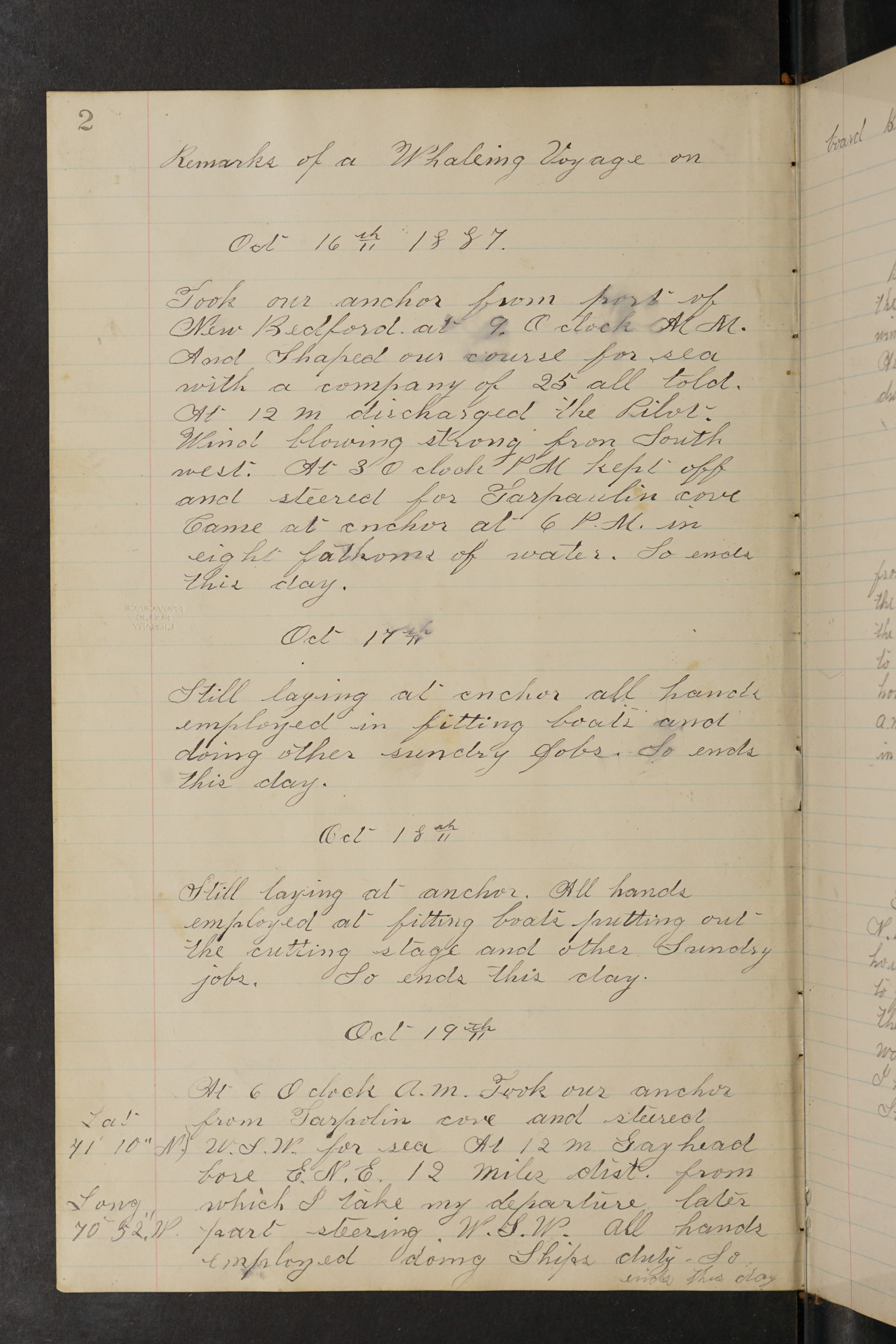
1media/logbook-1887/thumbs/1887-logbook-thumb-006.jpg2022-06-07T19:11:28+00:00Jordan Goffin051e893d1adf4975a3ccfe543e6b32c8bf77482d13Page 2 of the 1887 logbook, commencing the voyageplain2022-08-12T19:49:45+00:001887-10-1941.1666666666667,-70.8666666666667Jordan Goffin051e893d1adf4975a3ccfe543e6b32c8bf77482d
This page has paths:
12023-01-23T18:12:53+00:00Jordan Goffin051e893d1adf4975a3ccfe543e6b32c8bf77482dMap of the 1887 voyage as recorded in the logbook (path)Jordan Goffin3One of the daily latitude longitude readings for each page of the logbook has been used, offering a rough approximation of the voyage's routeplain2023-01-23T19:43:18+00:00Jordan Goffin051e893d1adf4975a3ccfe543e6b32c8bf77482d
12022-06-01T20:46:14+00:00Jordan Goffin051e893d1adf4975a3ccfe543e6b32c8bf77482dLogbook of the 1887 voyageJordan Goffin13plain2023-02-06T21:33:49+00:00Jordan Goffin051e893d1adf4975a3ccfe543e6b32c8bf77482d
This page is referenced by:
12022-06-01T20:46:06+00:00The 1887 Voyage10plain2024-03-22T20:55:27+00:00As recorded in the logbook's first entry, the Eunice H. Adams weighed anchor on October 16th, 1887 and headed out to sea.
Martin’s last voyage as master of the Eunice H. Adams that left New Bedford for the North Atlantic on October 16, 1887, was difficult and ended badly. The ship’s log offers some details of the trip. The concise and legible log generally records only what was important: the date, weather, and sometimes location of the ship. Entries finish with “So ends this day”—exceptions sometimes include the information that he saw nothing, no other ships or creatures. It appears the first mate, Arthur O. Gibbons, was the writer. Incessant high winds and bad weather hampered the trip: “the wind blew so that we could not lower the boats”; “strong winds”; “heavy” and “continuous gales”; “squally with rain” were the expressions most commonly used from October 1887 to January 1890, the last month of Captain Martin’s time on board.
By the end of the voyage, forty-seven men had served on the crew (including Martin and his replacement captain, Thomas E. Fordham), and between eight and fourteen men had deserted. And there are no indications of crewmen being punished. The captain provided for occasional leave for the entire crew. The crew several times refused to work, but in each instance Martin was able to reengage them, so his managerial skills seemed adequate. The constant references to the ship leaking, harpoons breaking, major and minor accidents—and miserable weather—certainly reflect conditions that did not contribute to the happiness of the crew.